
 By ando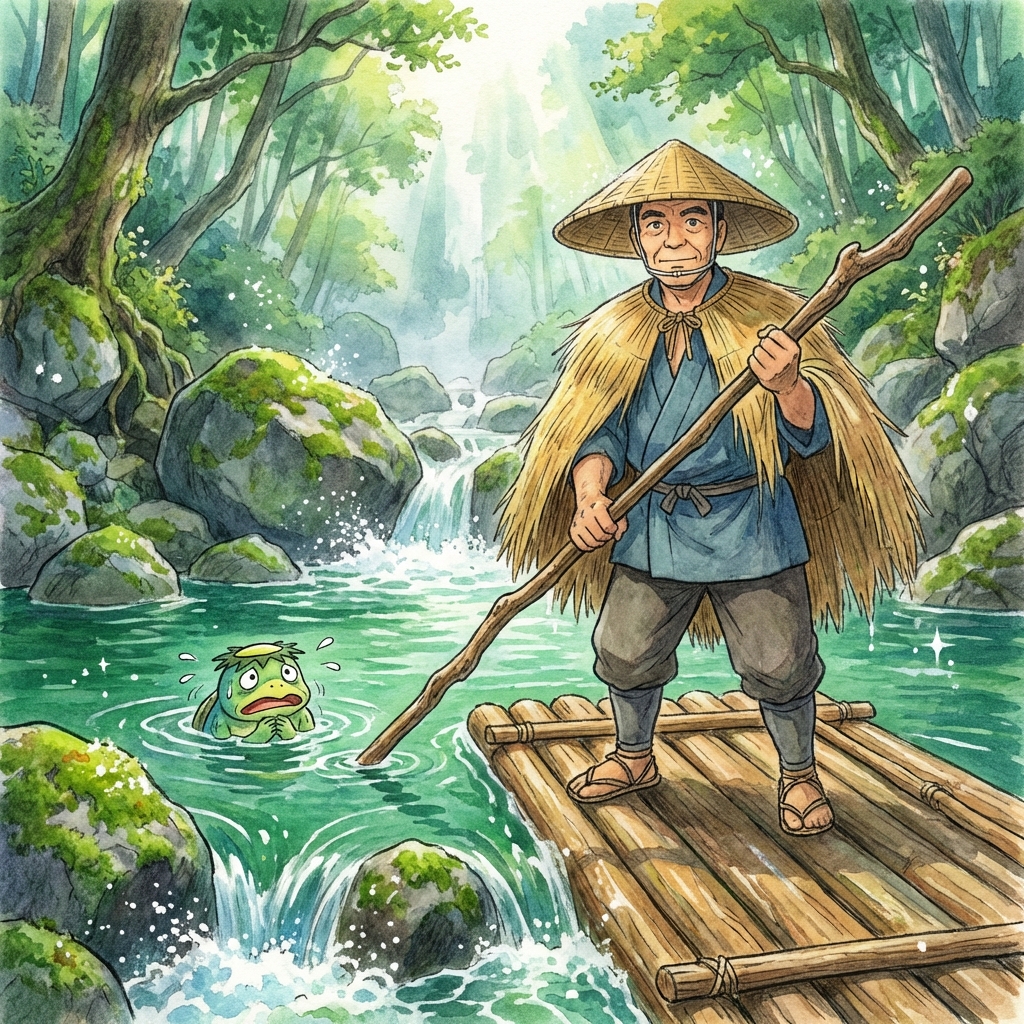
Kutsuki Ogawa, located in Takashima City, Shiga Prefecture, sits at the uppermost reaches of the Harihata River, a tributary of the Ado River. In this deep mountain village, a jinja with an exceptionally rare name, found nowhere else in Japan outside this river basin, is enshrined. That jinja is Omokobuchi Jinja.
This time, we will introduce this mysterious jinja, where the life-risking history of raftmen and legends of river-dwelling monsters come to life.
Basic Information
Name: Omokobuchi Jinja (おもこぶちじんじゃ)
Location: 566 Kutsuki Ogawa, Takashima City, Shiga Prefecture
Enshrined kami: Omokobuchi no kami (おもこぶちのかみ)
Cultural Properties: The main sanctuary (honden), Zao Gongen-sha, and Kumano-sha (three buildings) are designated National Important Cultural Properties (designated in 2015).
—
Legend: Raftsman “Shikobuchi-san” and the Kappa’s Vow
Essential to understanding this jinja is the legend of “Shikobuchi-san,” passed down in the Ado River basin.
Lumber cut from the Kutsuki mountains was once assembled into rafts (ikada) and floated down the Ado River to Lake Biwa. The river’s currents were swift, however, with treacherous pools (fuchi) and difficult sections everywhere, making it a constant life-risking job for raftmen.
According to tradition, long ago, when the skilled raftsman “Shikobuchi-san” was descending the river with his son, a “Gataro” (kappa) lurking in the river tried to drag his son to the riverbed. An enraged Shikobuchi-san beat the kappa severely with his pole, punishing it thoroughly.
Shikobuchi-san made the begging kappa swear an oath:
“Never again lay a hand on a raftsman wearing a sedge (suge) straw cape and hat, toad (gama) gaiters, and carrying a kobushi pole.”
Since then, raftmen in this region have prayed for safety by donning these “three items of equipment,” and Shikobuchi-san came to be enshrined as a guardian kami of the river.
—
Mystery: The “Seven Shikobuchi” Scattered Only in the Ado River Basin
The name “Shikobuchi” has a mysterious sound. In fact, jinja enshrining this kami exist only within a narrow area from the source to the lower reaches of the Ado River.
The seven main jinja are particularly called the “Seven Shikobuchi,” and Omokobuchi Jinja in Kutsuki Ogawa is counted as one of them.
Origin of the name: “Shiko” is said to be related to “shiko” (ugly/strong), meaning a strong or fearsome entity, while “buchi” refers to “fuchi,” the treacherous pools in the river.
It is believed that the awe felt by ancient people, who enshrined kami at each difficult point in the river to pacify the raging power of the water, created this unique belief.
—
Behind the Story: Important Cultural Property Shrine Buildings Frozen in Time Since the 14th Century
Omokobuchi Jinja in Kutsuki Ogawa is special not only for its legends. Deep within the jinja grounds, inside an “ooi-ya” (protective shelter) built to shield them from snow and rain, three extremely valuable shrine buildings (shaden) constructed in the early Muromachi period (1371) are preserved side by side.
Medieval techniques: They strongly retain the style of medieval jinja architecture, such as parts finished with a ‘yariganna’ (a type of plane) without the use of nails.
Miraculous state of preservation: Due to its remote mountainous location, it escaped war and development, preserving its original appearance for over 650 years.
Stepping inside, combined with the silence of the surrounding deep forest, you are enveloped in a serene atmosphere, as if you have traveled back in time to medieval Japan.
—
Visiting Points
Kutsuki Ogawa is truly like a “hidden village,” located even further beyond the “Saba Kaido” (Mackerel Road), which once connected Kyoto and Wakasa. Access by public transport is very limited, so a visit by car is recommended.
While listening to the murmuring of the river, why not reflect on the brave figures of the raftmen who once challenged these fierce currents, and the presence of kappa that might still be lurking in the pools?
Related Links and References
[1] https://imashiga.jp/blog/%E6%97%A5%E6%9C%AC%E9%81%BA%E7%94%A3%E3%83%BB%E7%90%B5%E7%90%B6%E6%B9%96%E3%80%80%E7%A5%88%E3%82%8A%E3%81%A8%E6%9A%AE%E3%82%89%E3%81%97%E3%81%AE%E6%B0%B4%E9%81%BA%E7%94%A3%E3%80%80%E3%82%B7%E3%82%B3/
[2] 地域から見る 文化遺産オンライン
[3] 思子淵神社 熊野社 文化遺産オンライン
[4] https://www.sugatani.co.jp/blog/?p=4124
[5] しこぶちさん : ゲ ジ デ ジ 通 信
[6] https://log.deep-exp.com/ja/media/791
[7] シコブチ 神社の神様 – 神社ファン
[8] 滋賀県高島市 小川思子淵神社
[9] シコブチ信仰 | びわ湖高島文化財めぐり
[10] ものしり百科
[11] 朽木(くつき)のシコブチさん − 志子淵神社(滋賀県高島市朽木)|izayoi books – 物語の散歩道 すみがき たけし
[12] 七シコブチの物語 – NANASAN(ナナサン) | 滋賀のお菓子
[13] 七シコブチ – Wikipedia